The financial services industry is experiencing a profound paradigm shift. As data volumes explode and market complexities grow, financial analysts, investment professionals, and CFOs face mounting pressure to deliver rapid, accurate insights. Traditional manual workflows are no longer sufficient to keep pace with this rapidly changing environment.
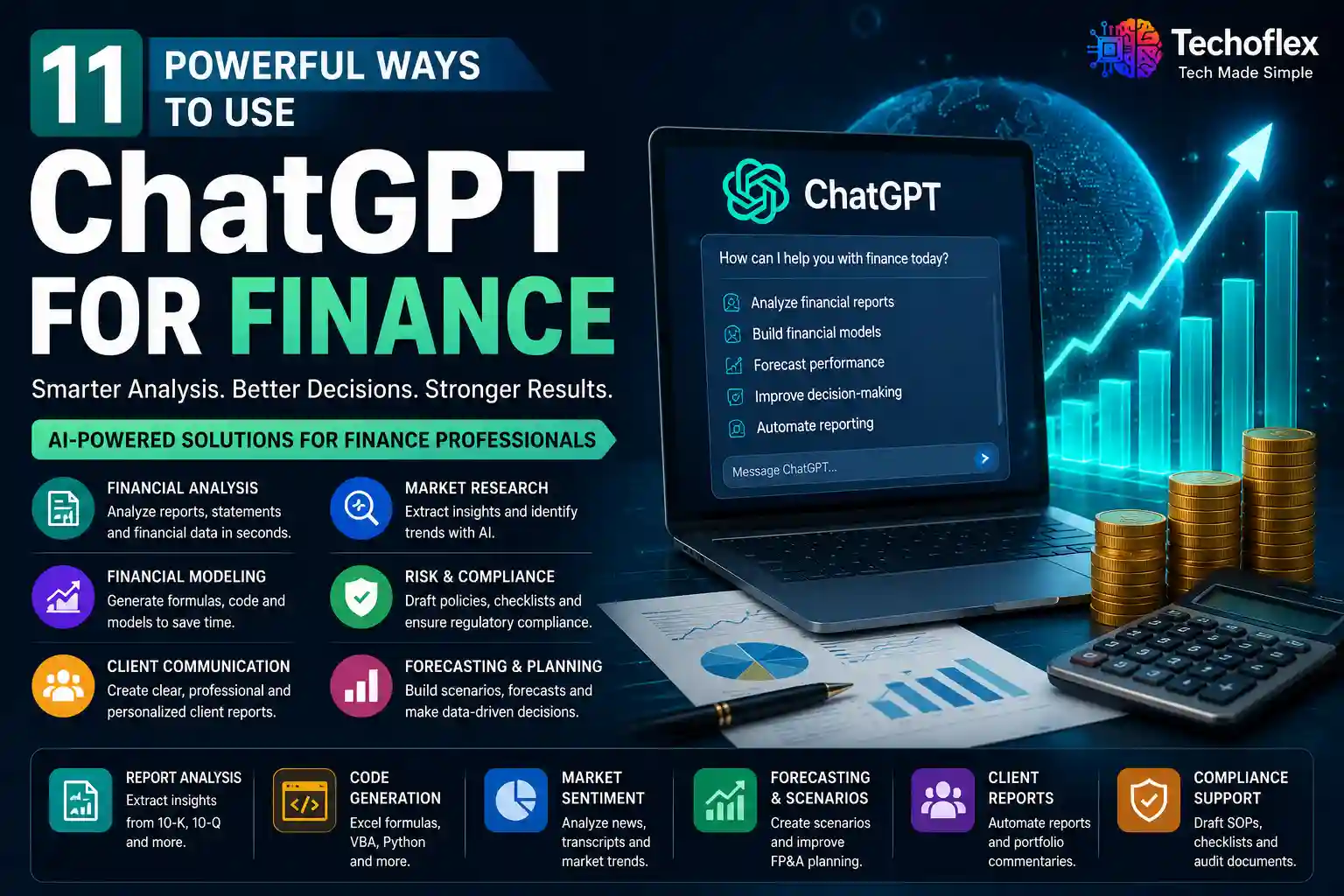
11 Powerful Ways to Use ChatGPT for Finance
Artificial intelligence is transforming this sector, offering unprecedented automation and predictive capabilities. At the forefront of this shift is generative AI, which is fundamentally changing how professionals interact with complex datasets. Understanding how to leverage chatgpt for finance has transitioned from a competitive advantage to a core operational necessity. This comprehensive guide explores actionable strategies, advanced prompts, and implementation frameworks to safely integrate ChatGPT into your financial operations while maintaining rigorous data security and regulatory compliance.
1. Automated Financial Report Analysis and Synthesis
Modern financial professionals are inundated with lengthy documents, from annual 10-K filings to complex regulatory disclosures. Manually extracting key metrics and identifying hidden risks from these hundreds of pages is both time-consuming and prone to human error.
Streamlining 10-K and 10-Q Review
ChatGPT can process dense financial documents to instantly extract critical insights. By uploading PDFs or pasting text sections, users can instruct the model to isolate management commentary, identify changes in risk factors, or pull specific financial metrics from footnotes that might otherwise be overlooked.
Advanced Prompt for Report Parsing
“Act as a Senior Equity Research Analyst. Analyze the attached Management Discussion and Analysis (MD&A) section from the latest 10-K filing. Identify the top three operational risks highlighted by management, summarize the capital allocation strategy, and extract any explicit guidance provided for the next fiscal year. Format the output with clear headings and a bulleted summary of key metrics.”
2. Financial Modeling Assistance and Code Generation
Building and maintaining robust financial models is a cornerstone of investment banking, corporate finance, and equity research. Writing complex Excel formulas, debugging macros, and building Python scripts for data analysis often create significant operational bottlenecks.
ChatGPT is one of several powerful solutions featured in our guide to the top AI tools for finance.
Accelerating Spreadsheet Workflows
ChatGPT serves as an on-demand programming assistant. It can generate complex nested Excel formulas, write customized VBA macros to automate repetitive formatting tasks, and draft Python code using libraries like Pandas and NumPy to clean and analyze massive financial datasets.
3. Market Sentiment Analysis and Trend Detection
Investment decisions depend heavily on parsing public perception, news feeds, and earnings call transcripts. Processing unstructured textual data at scale to gauge market sentiment requires significant time and effort when done manually.
Processing Unstructured Textual Data
Using generative AI in finance allows teams to execute rapid sentiment scoring across hundreds of news articles, press releases, or earnings transcripts simultaneously. ChatGPT can evaluate the tone of an executive’s responses during a Q&A session, categorizing statements as bullish, bearish, or neutral, and highlighting subtle shifts in language compared to previous quarters.
Structuring Qualitative Insights
The table below demonstrates how ChatGPT can convert unstructured transcript data into structured, quantitative sentiment scores for executive commentary:
| Executive Quote | Core Theme | Sentiment Score (-1 to +1) |
|---|---|---|
| “We are facing temporary supply chain headwinds in Europe, but demand remains robust.” | Supply Chain / Demand | 0.2 (Mildly Positive) |
| “Operating margins compressed by 150 basis points due to persistent inflationary pressures.” | Margin Compression | -0.6 (Negative) |
| “Our new SaaS product line grew 45% year-over-year, outperforming our initial internal targets.” | Product Growth | 0.9 (Strongly Positive) |
4. Predictive Forecasting and Scenario Planning
Corporate financial planning and analysis (FP&A) teams must constantly prepare for multiple future economic states. Developing realistic revenue scenarios and stress-testing financial models against macro shocks is critical for strategic resilience.
Enhancing FP&A Frameworks
While ChatGPT does not inherently run dynamic quantitative simulations on its own, it excels at structuring the narrative frameworks, identifying relevant macroeconomic variables, and generating the logical parameters needed for multi-scenario planning. It helps analysts define baseline, upside, and downside assumptions by synthesizing historical economic responses to inflation, interest rate hikes, or supply disruptions.
Structuring Scenario Parameters
- Upside Scenario: Accelerating market adoption, falling raw material costs, and 3% industry growth.
- Baseline Scenario: Linear historical growth, stable inflation, and consistent customer retention rates.
- Downside Scenario: Prolonged supply chain disruption, a 200 bps interest rate increase, and localized labor shortages.
5. Automated Client Communication and Report Generation
Wealth managers, financial advisors, and investor relations teams spend hours drafting personalized updates, portfolio commentaries, and performance explanations for clients and shareholders.
Scalable Personalization
ChatGPT can transform raw portfolio performance metrics into polished, professional summaries tailored to specific target audiences. Whether translating complex quantitative shifts into accessible language for retail clients or drafting highly technical updates for institutional investors, generative models dramatically cut down writing time while maintaining a consistent institutional voice.
Prompt for Client Commentary
“Draft a 300-word quarterly portfolio commentary for a high-net-worth retail client. Explain that the portfolio experienced a 4% growth this quarter, driven by strong tech sector performance, while bond allocations acted as a stabilizing hedge against market volatility. Use an authoritative, reassuring, and professional tone.”
6. Financial Compliance and Risk Management Documentation
Navigating the complex maze of financial regulations (such as KYC, AML, and MiFID II) requires meticulous documentation and constant compliance monitoring. Keeping internal policies aligned with changing legal requirements poses a significant operational burden.
Drafting Audit-Ready Policies
ChatGPT accelerates the creation of internal policy drafts, compliance checklists, and standard operating procedures (SOPs). By feeding the model updated regulatory guidelines, compliance officers can quickly generate comprehensive internal documentation that ensures all team members adhere to the latest operational standards, significantly reducing regulatory risk.
Compliance Checklist Template
- Verify client identity against authoritative government registries (KYC verification).
- Screen all beneficial owners against global sanctions and Politically Exposed Persons (PEP) lists.
- Document the source of funds for transactions exceeding regulatory thresholds.
- Archive all communication logs and verification documents in an immutable, audit-ready database.
Frequently Asked Questions
Is it safe to upload confidential financial data to ChatGPT?
No, you should never upload proprietary, confidential, or personally identifiable financial data to the standard public version of ChatGPT. Standard user inputs are utilized to train future iterations of the model. To safely handle sensitive data, organizations must utilize enterprise-grade solutions (such as ChatGPT Enterprise or API integrations via secure cloud environments) that explicitly guarantee data privacy, zero model training on user inputs, and SOC 2 compliance.
Can ChatGPT replace professional financial analysts?
No, ChatGPT cannot replace professional financial analysts. It operates as a highly sophisticated productivity multiplier rather than an autonomous decision-maker. Generative AI lacks real-world intuition, strategic judgment, and accountability. It is prone to “hallucinations” (generating inaccurate facts or figures), meaning all AI-generated formulas, code, and analyses must be thoroughly vetted by qualified professionals.
What are the primary limitations of using ChatGPT for finance?
The primary limitations include its potential to generate inaccurate calculations (hallucinations), its lack of real-time market data access in standard configurations, and its inability to understand context outside of its training data or provided prompt context. Furthermore, because it relies on pattern matching rather than factual reasoning, it cannot replace rigorous mathematical verification or human oversight in critical financial tasks.
Conclusion
Integrating ChatGPT into your financial workflows offers an unparalleled opportunity to eliminate administrative bottlenecks, accelerate data analysis, and scale client communication. By acting as an on-demand technical assistant for report synthesis, code generation, and policy drafting, generative AI empowers finance professionals to shift their focus from repetitive data gathering to high-value strategic decision-making.
However, successful adoption requires a balanced approach. Organizations must prioritize data security by using enterprise-grade AI platforms, enforcing strict oversight to mitigate hallucination risks, and ensuring human expertise remains at the center of every analytical process. Embracing these advanced workflows safely will separate the market leaders from the laggards in this new era of AI-driven finance.