Artificial Intelligence has evolved from a futuristic novelty into a core driver of modern business efficiency. For enterprises, entrepreneurs, and digital professionals, choosing the right foundational AI tool is no longer just about experimenting with technology—it is a critical strategic decision that impacts operational velocity, software development cycles, and content production pipelines. Two dominant forces lead this market: OpenAI’s ChatGPT and Anthropic’s Claude. Both platforms offer remarkable natural language processing capabilities, but they are built on fundamentally different philosophies, architectures, and design priorities.
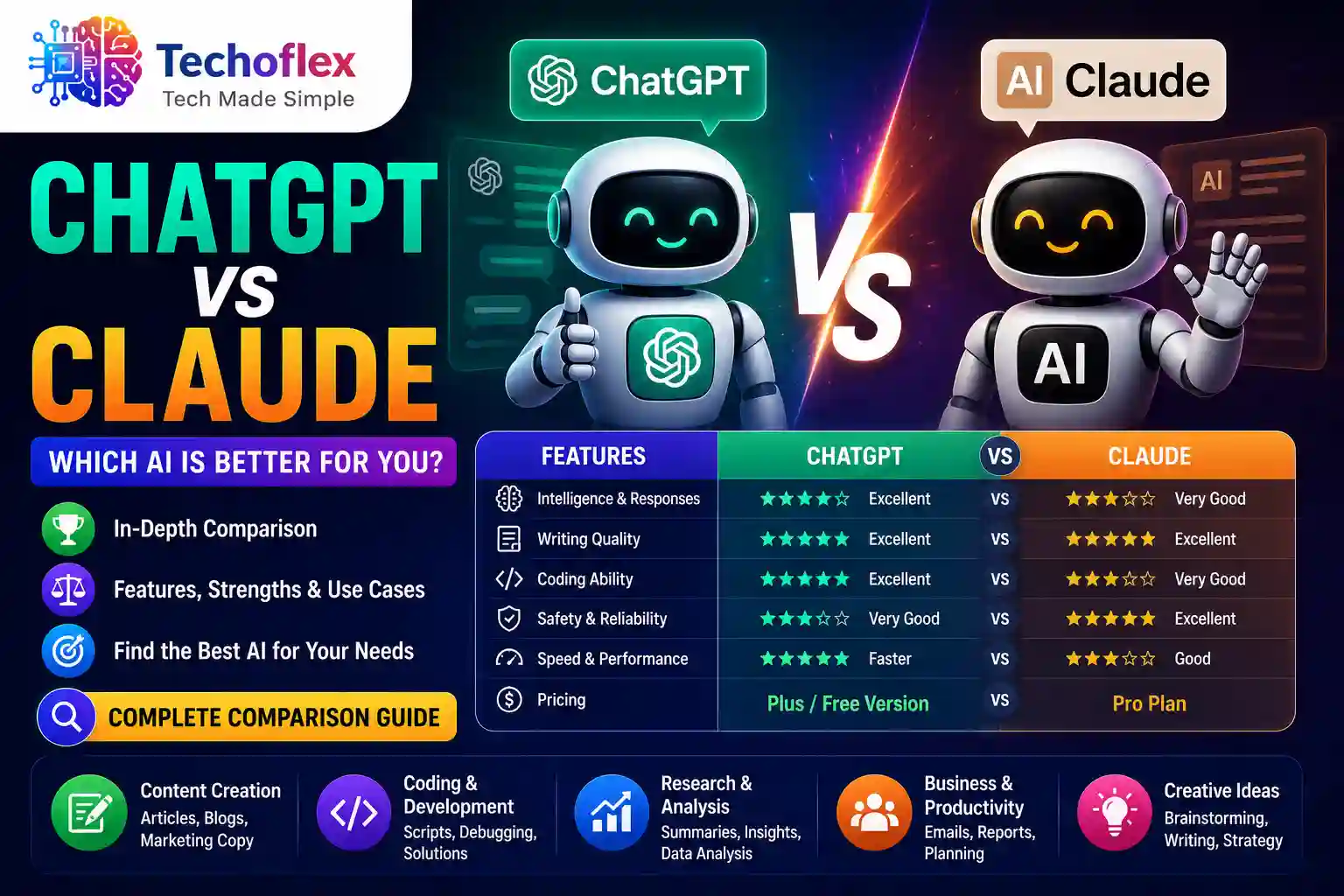
ChatGPT vs Claude: Which AI Model Delivers Better Results
When assessing ChatGPT vs Claude, professionals must look past marketing hype to evaluate how these Large Language Models (LLMs) perform under rigorous, real-world conditions. A choice that favors one over the other can alter your content quality, programming workflows, and data compliance posture. This comprehensive analysis evaluates both systems across key performance vectors, including reasoning, coding capabilities, mathematical logic, contextual memory, and enterprise-grade security, helping you determine which model aligns with your operational goals.
1. Architectural Foundations and Philosophy: Understanding the AI Engines
To understand the practical output differences between ChatGPT and Claude, it is necessary to examine the underlying philosophy and development architecture established by their respective creators, OpenAI and Anthropic.
OpenAI’s Performance-Driven Approach
OpenAI’s engineering culture heavily emphasizes raw capability, multi-modal versatility, and rapid deployment. ChatGPT, powered by the GPT-4 and GPT-4o architectures, is designed as a generalized, highly capable computational engine. OpenAI relies on extensive Reinforcement Learning from Human Feedback (RLHF) to optimize its models for task execution, speed, and versatility. This approach positions ChatGPT as an agile tool capable of pivoting seamlessly between diverse tasks, from executing python code in a sandbox environment to generating digital art via DALL-E 3.
Anthropic’s Constitutional AI Framework
Anthropic, founded by former OpenAI researchers, took a divergent path by prioritizing safety, alignment, and predictability. Claude operates on a framework known as Constitutional AI. Instead of relying solely on human feedback—which can introduce biases or inconsistencies—Anthropic trains Claude using a set of written principles (a “constitution”) derived from sources like the UN Declaration of Human Rights and best practices in data security. This creates a model that is inherently more transparent, less prone to generating harmful outputs, and exceptionally skilled at nuanced text analysis and objective reporting.
2. Reasoning and Complex Data Analysis
For strategic planning, legal review, and technical synthesis, an AI’s capacity for advanced reasoning is its most critical asset. Both models handle basic instructions effortlessly, but their performance diverges when handling multi-layered logical constraints.
| Evaluation Metric | ChatGPT (GPT-4o) | Claude (3.5 Sonnet)
|
|---|---|---|
| Context Window Capacity | 128,000 tokens (~96,000 words) | 200,000 tokens (~150,000 words) |
| Information Retrieval Accuracy | High; prone to occasional hallucinations in long text | Exceptional; near-perfect “needle in a haystack” retrieval |
| Analytical Tone | Direct, structured, output-focused | Nuanced, academic, context-aware |
Claude’s massive 200,000-token context window allows users to upload entire financial ledgers, legal contracts, or multi-chapter books simultaneously. In benchmark tests analyzing dense data retrieval, Claude demonstrates superior accuracy, identifying specific data points hidden deep within massive documents without dropping critical context. ChatGPT handles complex data effectively but operates within a smaller 128,000-token window, occasionally requiring users to break large datasets into smaller chunks to maintain analytical precision.
3. Advanced Coding and Software Engineering Performance
Software engineers and technical teams heavily leverage LLMs for debugging, code generation, and system architecture design. Evaluating Claude vs ChatGPT for coding reveals distinct behavioral patterns in code generation and testing.
- Syntax Generation and Accuracy: Claude (specifically the Claude 3.5 Sonnet model) has set new industry benchmarks for coding proficiency. It excels at understanding full code repositories, refactoring legacy codebases, and generating clean, dry (Don’t Repeat Yourself) syntax across languages like Python, TypeScript, and Rust.
- Execution Environments: ChatGPT maintains a strong advantage with its native Advanced Data Analysis tool. This feature provides a sandboxed Python execution environment, allowing ChatGPT to run code in real-time, test its own scripts, fix bugs dynamically, and output calculated results or rendered charts directly to the user.
- Debugging and Error Analysis: While ChatGPT can execute and fix code iteratively via its runtime sandbox, Claude reads through static code blocks with an analytical eye, frequently identifying logical edge cases and architectural vulnerabilities that other models overlook.
4. Mathematical Logic and Problem-Solving Capabilities
Mathematical reasoning has historically challenged large language models due to their auto-regressive, token-prediction nature. However, recent architectural upgrades have transformed how both platforms approach quantitative reasoning.
ChatGPT utilizes specialized reasoning paths and internal chain-of-thought processing models (such as the OpenAI o1 series). When presented with intricate math problems, accounting challenges, or statistical data, it explicitly breaks down the problem statement before generating a final answer, which significantly reduces computational errors. This makes ChatGPT highly dependable for structured engineering equations and financial forecasting calculations.
Claude approaches mathematics with a linguistic and logical perspective. It excels at explaining the theoretical concepts behind mathematical proofs and interpreting statistical outcomes within business contexts. However, for pure numerical computation and multi-step computational problems, ChatGPT’s dedicated reasoning frameworks frequently deliver a higher level of structural accuracy.
5. Contextual Memory, UI Features, and Workspace Workflows
As AI tools embed themselves into daily business operations, user experience design and workflow integrations dictate long-term productivity gains.
ChatGPT’s Custom GPTs and Voice Mode
OpenAI provides a robust ecosystem geared toward personalization and multi-modal interaction. Users can construct “Custom GPTs”—specialized instances of ChatGPT configured with specific instructions, uploaded files, and custom API actions. This allows teams to create bespoke internal tools without writing code. Furthermore, ChatGPT’s advanced voice mode offers realistic, low-latency conversational capabilities, facilitating fluid verbal brainstorming and real-time audio translation.
Claude’s Artifacts Workspace
Anthropic introduces a distinct approach to collaborative workflow with its Artifacts feature. When Claude generates a dedicated asset—such as a piece of code, an interactive HTML page, a vector graphic, or a comprehensive document—it opens a dedicated, real-time side window next to the conversation. This splits the user interface into a chat zone and a workspace zone. Developers and designers can view, edit, and iterate on the generated asset live, providing an optimized environment for iterative design and software prototyping.
6. Security, Compliance, and Enterprise-Grade Data Governance
For enterprise adoption, data privacy, regulatory compliance, and security frameworks are non-negotiable requirements when evaluating AI deployments.
Anthropic engineered Claude with a strict emphasis on enterprise data privacy. By default, data submitted through Claude’s business and enterprise tiers is never used to train future iterations of their large language models. Claude complies fully with SOC 2 Type II security requirements, is HIPAA-supportive for healthcare data environments, and aligns with strict GDPR data-handling mandates. This stringent posture makes Claude a preferred option for legal teams, financial institutions, and medical organizations handling sensitive intellectual property.
OpenAI offers comparable enterprise protections through its ChatGPT Enterprise and Team tiers, providing complete data encryption, administrative controls, and a clear policy stating that customer prompts are excluded from model training datasets. However, because ChatGPT supports third-party plugins and custom actions that interact with external web APIs, enterprise IT administrators must implement more granular access controls to prevent accidental data exposure through external integrations.
7. Cost-to-Value Mapping: Pricing Structures for Teams and Developers
Maximizing ROI requires an understanding of how both platforms structure their pricing across web interfaces and developer APIs.
- Free Tiers: Both companies provide free web-based access. OpenAI offers limited access to its flagship GPT-4o model before downgrading users to the smaller GPT-4o-mini engine. Anthropic offers access to Claude 3.5 Sonnet with strict message volume caps that reset every few hours depending on server demand.
- Premium Subscriptions: ChatGPT Plus and Claude Pro are priced symmetrically at $20 per user per month. Upgrading unlocks higher usage caps (typically 5x more messages) and priority access during peak traffic windows.
- API Pricing Structure: For developers embedding these models into applications, pricing is calculated per million tokens. Claude 3.5 Sonnet offers highly competitive pricing given its performance benchmarks, balanced between input processing costs and generation outputs. OpenAI provides a broader spectrum of API tiers, from budget-friendly mini models to premium reasoning engines, allowing developers to optimize costs based on task complexity.
Frequently Asked Questions (FAQ)
Is Claude better than ChatGPT for writing long-form content?
Yes, Claude is widely considered superior for long-form content creation, editing, and thematic analysis. Thanks to its 200,000-token context window and its sophisticated Constitutional AI training, Claude generates text that features an authoritative, natural tone, fluid transitions, and a notable absence of repetitive “AI clichés.” This makes it highly effective for drafting research reports, detailed whitepapers, and comprehensive articles.
Can ChatGPT browse the live web and look up current data?
Yes. ChatGPT features built-in web browsing capabilities that allow it to search the internet in real-time, fetch up-to-date information, and cite its sources directly within the conversation window. Claude can also access web search capabilities in its current versions, ensuring that both platforms can assist with real-time research and time-sensitive inquiries.
Which AI model is safer for handling sensitive corporate data?
While both platforms provide robust enterprise data security tiers, Anthropic’s Claude is built from the ground up on Constitutional AI principles, prioritizing data safety and regulatory alignment. On corporate and API tiers, both Anthropic and OpenAI guarantee that user data is encrypted and completely excluded from model training pipelines, fulfilling standard corporate compliance requirements.
Conclusion: Strategic Deployment of AI Tools
The choice between ChatGPT and Claude is not a matter of finding a universally superior model; it is about matching specific business challenges to the distinct strengths of each AI engine.
Choose ChatGPT if: Your team requires a highly versatile, multi-modal workspace that integrates voice communication, real-time sandboxed python execution, custom integrations, and specialized GPT applications that automate routine team workflows.
Choose Claude if: Your primary objectives demand rigorous logical analysis of extensive documents, complex software engineering workflows, clean code refactoring, and high-quality, long-form content written in an authentic, professional tone.
To maximize operational velocity, many leading modern enterprises choose not to limit themselves to a single ecosystem. Instead, they integrate both platforms—deploying ChatGPT for execution-heavy tasks, automation workflows, and active data visualization, while relying on Claude for technical writing, in-depth document synthesis, and large-scale software development projects.