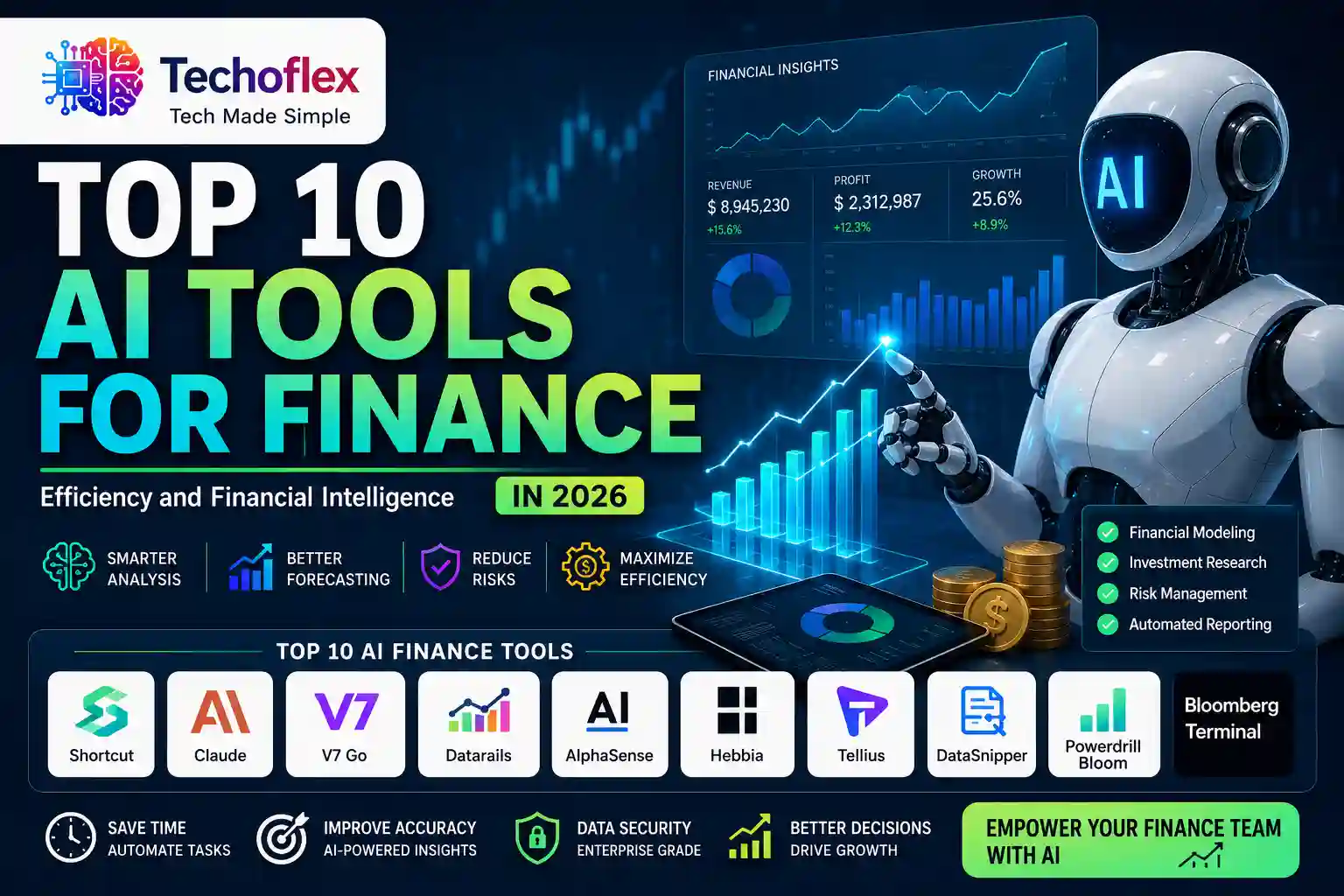
The financial landscape is experiencing an unprecedented evolution. As transaction velocities increase and economic data grows exponentially, traditional spreadsheets and manual auditing workflows are becoming operational bottlenecks. Modern financial analysts, Chief Financial Officers (CFOs), and investment managers require tools that process information in real-time, enforce absolute data integrity, and surface predictive insights instantly.
If you’re new to artificial intelligence, start with our guide on AI tools for beginners before exploring advanced finance platforms.
Artificial intelligence has stepped into this vacuum, transforming the industry from reactive accounting to proactive, strategic forecasting. By implementing specialized AI tools, corporate finance teams, wealth managers, and investment bankers are cutting down review cycles, optimizing portfolios, and uncovering hidden risks with remarkable speed. This definitive guide explores the top 10 AI tools for finance, ranking them by specific use cases, core capabilities, and operational strengths.
1. Shortcut: Best for Institutional Financial Modeling
For decades, building integrated financial models remained an exclusively human domain requiring elite technical skills. Shortcut, an advanced Excel add-in developed by Fundamental Research Labs, changes this by automating the creation of institutional-grade, three-statement models.
Excel-Native Automation
Unlike standard large language models (LLMs) that require you to copy and paste code out of a browser, Shortcut embeds directly into your existing desktop Excel architecture. It evaluates real SEC filings and market consensus data to structure clean, fully integrated financial statements.
Rigorous Forecasting Standards
In rigorous industry benchmark testing, Shortcut outpaced leading general-purpose AI models in data extraction speed, formatting consistency, and balance sheet integration. It enforces financial best practices, eliminating the manual transposition errors that typically plague junior analyst workflows.
2. Claude (Anthropic): Best for Advanced Financial Coding & Formula Logic
Anthropic’s Claude (specifically leveraging the latest iterations) has become the preferred AI tool for complex quantitative reasoning, multi-file financial refactoring, and programmatic analysis.
Claude has become popular among finance professionals due to its reasoning capabilities. You can also read our detailed ChatGPT vs Claude comparison.
Advanced Excel and Code Engineering
Finance teams often scale past standard Excel limits and require custom scripts. Claude excels at writing, debugging, and explaining complex Python logic utilizing libraries like Pandas and NumPy, as well as developing advanced VBA macros.
The Analyst’s Technical Escalation Tool
When multi-step analytical problems cause traditional chatbots to fail, Claude remains highly dependable. It easily reads intricate loan amortization schedules, builds cross-document corporate memory, and writes robust nested formulas while prioritizing transparent source attribution.
3. V7 Go: Best for High-Volume Due Diligence & M&A Data Rooms
Investment banking and private equity workflows frequently stall during the document-heavy due diligence phase, where hundreds of PDFs, scanned images, and handwritten notes must be audited. V7 Go solves this by deploying specialized, autonomous AI due diligence agents.
Eliminating Mathematical Hallucinations
A persistent issue with standard generative AI is its tendency to make mistakes with basic math. V7 Go bypasses this limitation with a hybrid processing engine that dynamically switches from LLM contextual reasoning to a deterministic calculation engine for financial math.
Granular Source Verification
-
Multimodal Ingestion: Processes scanned K-1s, irregular cap tables, and multi-year financials without losing data to high-level summarization.
-
Absolute Attribution: Every extracted figure, interest coverage ratio, or debt covenant is linked directly back to its exact source page and paragraph location, providing a bulletproof audit trail.
4. Datarails: Best for Excel-Native FP&A Consolidation
Many financial planning and analysis (FP&A) teams waste days manually aggregating data from different departments because they refuse to abandon the flexibility of Microsoft Excel. Datarails acts as an intelligent enterprise overlay that transforms Excel into a centralized financial hub.
Automated Close & Version Control
Datarails automatically consolidates fragmented spreadsheets from across an organization while maintaining strict version control and error checking. It eliminates the risk of working with broken links or outdated files.
Natural Language Data Queries
Once your data is consolidated, the platform allows finance leaders to use natural language to query their records. Analysts can ask questions like “What drove our budget variance in corporate travel last month?” and instantly receive a visual breakdown without building manual pivot tables.
5. AlphaSense: Best for Market Intelligence & Investment Research
AlphaSense is an industry-leading, AI-driven market intelligence platform trusted by equity research analysts and corporate strategists. It indexes and searches over 10,000 premium financial data sources simultaneously.
Sifting Through the Noise
The platform uses advanced natural language processing (NLP) to instantly scan broker research, SEC filings, global news, and earnings call transcripts.
Smart Synonym & Sentiment Matching
AlphaSense understands financial intent. If you search for “margin compression,” the AI automatically highlights related concepts like “input cost pressure” or “raw material headwinds,” ensuring analysts never miss subtle warnings in competitor commentary.
6. Hebbia: Best for Unstructured Data Analysis & Risk Triage
Hebbia relies on multi-agent reasoning to answer highly complex questions across massive, unstructured document data rooms. It acts as an on-demand virtual analyst that has meticulously read every single page of your corporate records.
Cross-Document Synthesis
Instead of simple keyword matching, Hebbia maps conceptual relationships across thousands of separate files.
Comprehensive Risk Assessments
Corporate legal and financial teams use Hebbia to instantly extract specialized insights, such as mapping every single change-of-control provision or debt restriction hidden across a target company’s historical contracts.
7. Tellius: Best for Automated Variance Analysis & Root Cause Detection
When financial performance metrics change unexpectedly, determining the exact cause can require hours of database querying. Tellius uses machine learning to automate root-cause investigation across your entire enterprise data stack.
Agentic Business Analytics
Tellius serves as an agent-based analytical layer that automatically monitors operational performance indicators.
Answering “Why” the Numbers Changed
Rather than simply charting a sudden spike in operating costs, Tellius uncovers the hidden drivers by analyzing multi-source records, revealing precisely which vendors, regions, or operational anomalies caused the variance.
8. DataSnipper: Best for External Auditing & Document Verification
For audit professionals, manual matching and verification of evidence can be a tedious process. DataSnipper builds intelligent automation directly into Excel to speed up the validation of financial records.
Reconciliation Automation
DataSnipper automatically cross-references and matches unstructured data from invoices, bank statements, and shipping documents directly against your general ledger entries.
Big 4 Grade Validation
The platform vastly increases audit coverage by moving teams past traditional random sampling. It leaves clear visual markers and links within your workbook, creating an audit-ready trail that drastically shortens internal and external review timelines.
9. Powerdrill Bloom: Best for Instant, Presentation-Ready Reporting
Raw financial data is only useful if it can be effectively communicated to executive leadership. Powerdrill Bloom bridges the gap between data cleaning and high-level corporate storytelling.
One-Click Executive Decks
Powerdrill imports complex financial ledgers and instantly formats them. With its specialized design engine, it converts raw spreadsheets into highly polished, “board-ready” presentations, charts, and infographics with a single click.
Interactive Dashboard Queries
It features a simple natural language interface, allowing board members and executives to interactively drill down into financial charts during presentations to clear up operational questions on the spot.
10. Bloomberg Terminal (with BloombergGPT): Best for Real-Time Global Market Analytics
The Bloomberg Terminal remains the definitive global standard for real-time market data, institutional execution, and macroeconomic analytics. By combining its classic data feeds with specialized financial LLMs, it offers a highly advanced analytics experience.
Command Line Natural Language Processing
Traders and institutional asset managers use integrated NLP commands to instantly query global markets, compare corporate fundamentals, and monitor news sentiment across the globe.
Unmatched Financial Context
Because the underlying AI is trained natively on decades of financial terminology, corporate actions, and market metrics, it interprets nuanced financial news with a level of context that general-purpose AI platforms cannot match.
Core AI Finance Tools Comparison
| Platform | Primary Target Audience | Core Strength / Use Case | Integration Type |
| Shortcut | Investment Bankers & Analysts | Institutional 3-statement financial modeling | Excel Desktop Add-In |
| Claude | Quantitative Analysts & Developers | Advanced financial programming & formula debugging | Web Browser / API |
| V7 Go | Private Equity & M&A Teams | Autonomous data room due diligence & zero-math-error extraction | Cloud Web Platform |
| Datarails | Mid-Market Corporate FP&A | Automated spreadsheet consolidation & natural language queries | Excel Native Overlay |
| AlphaSense | Equity Research & Asset Managers | High-velocity market intelligence across 10,000+ sources | Web / Enterprise App |
Frequently Asked Questions (Schema-Ready Q&A)
How do AI finance tools handle strict data privacy regulations like GDPR or SOC 2?
Enterprise-grade AI tools designed for finance protect sensitive information by using private cloud instances, strict data segregation, and end-to-end encryption. Premium tools guarantee that proprietary financial ledgers, customer metrics, and client communications are never used to train public models, ensuring full compliance with SOC 2 type II certifications and international privacy laws like GDPR.
Can AI financial modeling tools completely replace human junior analysts?
No. Industry benchmark tests show that even the most advanced financial modeling tools still underperform compared to a trained junior analyst when handling complex issues like financial circularity or unexpected shifts in model structure. AI tools function as productivity multipliers that eliminate manual typing and formatting, but they still require expert human review to verify assumptions and ensure accuracy.
What is the difference between general AI models and specialized financial AI platforms?
General AI tools (like standard ChatGPT) are trained on broad internet prose and often struggle with nuanced financial terminology, leading to mathematical hallucinations or logical errors. Specialized financial AI platforms use hybrid calculation engines, maintain direct pipelines to authoritative financial databases (such as SEC filings or S&P Capital IQ), and emphasize transparent source attribution.