The digital landscape is undergoing its most radical transformation since the birth of modern search engines. For over two decades, search engine optimization (SEO) has been the undisputed blueprint for capturing online visibility. Businesses poured billions of dollars into ranking on the coveted first page of Google, optimizing for blue links, and tracking traditional keyword metrics. However, the foundational rules of search are shifting right beneath our feet. Traditional search results are no longer the exclusive destination for users seeking answers online.
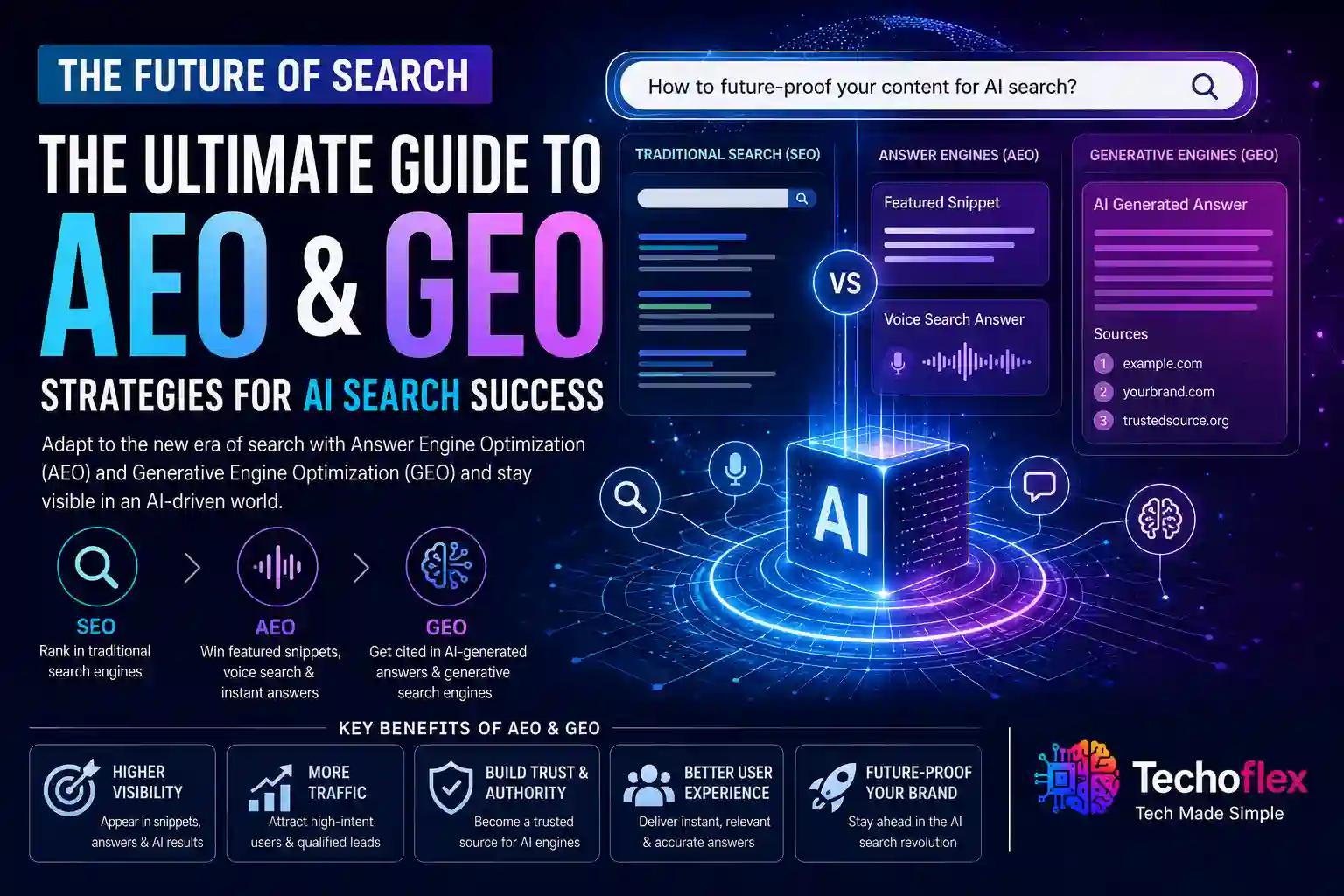
The Future of Search: The Ultimate Guide to AEO and GEO Success
The rapid evolution of artificial intelligence (AI), machine learning, and natural language processing (NLP) has triggered the rise of two revolutionary frameworks: Answer Engine Optimization (AEO) and Generative Engine Optimization (GEO). Users are no longer just searching for a list of websites; they are looking for immediate, synthesized, and contextually accurate answers. Devices like Amazon Alexa, Apple Siri, and Google Assistant have popularized voice search, while conversational AI engines like ChatGPT, Google Gemini, Microsoft Copilot, and Perplexity AI have permanently altered user behavior. Instead of filtering through dozens of pages, users demand that search engines filter the web for them, rendering a single, definitive response.
This reality introduces a massive problem for digital marketers, business owners, and content creators: if your brand is optimized solely for standard search engines, you risk becoming completely invisible in an AI-dominated market. When a generative engine handles a query, traditional organic click-through rates plummet because the user satisfies their intent without ever visiting an external website. To survive and thrive in this multi-modal search ecosystem, you must adapt your content strategy. The solution lies in mastering AEO and GEO alongside your core SEO practices, shifting from an era of traditional keyword targeting to one of comprehensive conversational intent optimization. This comprehensive guide will dissect the structural mechanics of AEO and GEO, map out actionable optimization blueprints, and show you exactly how to future-proof your digital presence for the next era of search.
1. The Evolution of Search: From SEO to AEO and GEO
To fully understand where search is going, we must trace where it has been. Traditional search engine optimization (SEO) focuses on helping search engines crawl, index, interpret, and rank web pages based on technical integrity, structural layout, keyword relevance, and backlink authority. The traditional search results page operates as an intermediary, matching user keywords to a curated index of hyperlinks and leaving it to the user to extract the precise answers they need.
The Rise of Answer Engine Optimization (AEO)
Answer Engine Optimization (AEO) emerged as a specialized sub-discipline of SEO to address the growth of conversational voice search and zero-click searches. An answer engine is any platform designed to provide a direct, concise answer to a user’s explicit question. Think of featured snippets on Google, pull-out knowledge panels, and voice responses delivered by smart home devices. Rather than analyzing a page’s overall thematic authority, AEO targets hyper-specific, bite-sized textual units that can easily be read aloud or displayed inside a structured box. AEO fundamentally shifted focus toward conversational natural language patterns and direct query resolution.
The Emergence of Generative Engine Optimization (GEO)
Generative Engine Optimization (GEO) represents the newest frontier in search strategy. It is the process of optimizing content to ensure it is selected, cited, and synthesized by generative AI search engines and search experiences—such as Google’s Search Generative Experience (SGE), Perplexity AI, and OpenAI’s search functionalities. Unlike traditional index-matching systems, generative engines ingest massive datasets, evaluate real-time search queries, and synthesize entirely new multi-paragraph responses complete with inline citations and interactive media. GEO requires a deep understanding of how Large Language Models (LLMs) interpret, weigh, and package information for users who converse with search engines like human experts.
2. Core Technical Differences: How Search, Answer, and Generative Engines Work
While SEO, AEO, and GEO intersect in their ultimate goal—maximizing brand visibility and authority—they rely on distinct technological mechanics. Developing a high-converting content strategy requires understanding how these platforms process data differently.
| Attribute | Search Engine Optimization (SEO) | Answer Engine Optimization (AEO) | Generative Engine Optimization (GEO) |
|---|---|---|---|
| Primary Mechanism | Keyword matching, link equity analysis, and programmatic page ranking models. | Semantic analysis, pattern matching, and extraction of structured micro-data snippets. | Retrieval-Augmented Generation (RAG), neural networks, vector search, and contextual synthesis. |
| Output Format | A list of structured organic blue hyperlinks accompanied by brief meta descriptions. | A single definitive voice response, single bulleted list, or a dedicated featured snippet box. | A multi-source, highly personalized text summary featuring inline reference links and follow-up prompts. |
| User Intent Focus | Informational, navigational, commercial, and transactional explicit queries. | Immediate, direct question-and-answer resolution and hyper-targeted commands. | Deep explorative research, multi-step scenarios, comparative analysis, and contextual problem-solving. |
| Key Performance Metric | Keyword positions, impressions, organic traffic volume, and organic click-through rate (CTR). | Share of voice, snippet ownership, and verbal brand mentions across assistant platforms. | Citation frequency, brand inclusion rate, sentiment attribution, and visibility inside AI summaries. |
Traditional SEO depends on text crawlers that index web documents based on density, heading structures, and explicit hyperlinks. AEO layers on top of this by scanning for semantic clarity and specific micro-formats, pulling data that fits exact conversational structures. GEO operates on an entirely different layer through Retrieval-Augmented Generation (RAG). When a user submits an complex prompt to a generative engine, the system performs a vector search across the web to pull relevant source documents, feeds these fragments into an LLM alongside the user prompt, and commands the AI to compile an authoritative, original narrative response. To win in GEO, your content must be structurally and textually optimized to serve as an indispensable source document within that generative loop.
3. Strategizing for AEO: Dominating Voice Search and Featured Snippets
To build an infrastructure optimized for Answer Engine Optimization (AEO), you must tailor your content to match the exact mechanics of conversational queries and structured voice environments. When a user asks a voice assistant for a recommendation, there is no second place; there is only a single chosen answer. Optimizing for this requires a deliberate emphasis on natural language structures and micro-data architectures.
Mastering Conversational Phrases and Long-Tail Questions
People type in short fragments, but they speak in full sentences. Traditional desktop searchers might type “best project management software enterprise,” but a voice searcher asks, “What is the best project management software for a mid-sized marketing agency?” Your content must explicitly incorporate these long-tail, natural-sounding question phrases. Shift away from rigid keyword stuffing and adopt an editorial style that mirrors genuine human dialogue. Integrate interrogative adverbs—Who, What, Where, When, Why, and How—naturally into your headers and body copy.
Structuring for Immediate Answer Delivery
Answer engines prioritize content that is formatted for instant consumption. Implement the inverted pyramid writing style: present your direct, definitive answer immediately at the start of a section, and follow up with supporting details, nuances, and context later. To capture Google’s featured snippets and voice assets, use the “Snippet Bait” approach. This involves creating a concise 40-to-60 word summary paragraph directly below a question-based H2 or H3 heading, allowing answer engine algorithms to easily extract the block for zero-click queries.
Implementing Robust Schema Markup
Schema markup serves as a digital translator for search engines. By applying structured data formats—such as FAQPage, Product, Article, and LocalBusiness schemas—you explicitly define what your data means, rather than relying on an algorithm to guess. If you present a list of prices, structuring them via Product schema ensures an answer engine can instantly state your pricing options during a voice query or within a conversational assistant output. Use JSON-LD formatting to keep your structured data perfectly accurate and up to date.
4. Cracking the GEO Code: Optimization Frameworks for Generative AI Search
Generative Engine Optimization (GEO) demands a complete rethinking of traditional search strategies. Because generative engines synthesize content rather than simply listing links, your writing must align with how LLMs process information. Recent academic research on GEO frameworks indicates that specific textual adjustments can drastically increase the likelihood of an AI model citing and selecting your content.
The Power of Citations and Authoritative Source Integration
Generative AI engines are explicitly designed to combat hallucinations by anchoring their answers to verified web sources. To make your content highly attractive to a RAG pipeline, you must back up your assertions with authoritative data, primary research, and high-quality outbound links to trusted institutions. When your content contains clear stats and verified references, LLMs recognize it as a high-fidelity reference source, leading to more frequent inline citations and brand placements within AI responses.
Enhancing Information Density and Analytical Depth
Generative search rewards content depth over superficial summaries. To optimize for LLM extraction, maximize the information density of your articles. Eliminate fluff, repetitive phrasing, and generic commentary. Instead, provide granular details, historical context, step-by-step breakdowns, and comprehensive comparative analysis. When your content covers every facet of a sub-topic with exceptional clarity, the generative model can extract multiple distinct sections of your page to build various parts of its synthesized summary.
The Role of Sentiment, Tone, and Linguistic Clarity
LLMs are deeply influenced by linguistic style, clarity, and authoritative sentiment. Write with technical precision and professional conviction. Avoid highly emotional or overly promotional hyperbole, as generative engines filter out explicit marketing bias in favor of objective, educational overviews. Use industry-standard jargon correctly and define complex concepts inline. Clear, unambiguous phrasing makes it easier for vector search models to map your content to relevant user query vectors.
5. Content Architecture for the Modern Multi-Engine Era
To capitalize on SEO, AEO, and GEO simultaneously, your website’s content architecture must be clean, highly logical, and multi-layered. You do not need to create separate content assets for each engine; instead, you should build unified assets designed to satisfy all three frameworks concurrently.
Developing In-Depth Hub and Spoke Topical Clusters
Establish a comprehensive hub-and-spoke content architecture to signal absolute topical authority to both traditional search crawlers and modern LLMs. A “Hub” page serves as an exhaustive, high-level overview of a broad topic, while individual “Spoke” articles dive deep into specific sub-topics, long-tail questions, and transactional search variations. Interlink these pages using precise, descriptive anchor text. This clear internal linking structure helps traditional crawlers pass link equity efficiently while allowing generative models to map the semantic relationships across your entire domain.
Designing High-Conversion UX Elements Within AI-Facing Content
Since generative search engines resolve many informational queries directly on their own interfaces, the users who *do* click through to your website will have higher intent and seek deeper insights. You must optimize their on-page experience for immediate conversion. Use clear, prominent calls-to-action (CTAs), embed interactive elements like calculators or assessment tools, and place downloadable lead magnets strategically within your copy. Ensure your site loads exceptionally fast and offers an intuitive mobile browsing experience to keep these high-value visitors engaged.
Strategic Insight: In the age of AI search, a page view is a rare commodity. When a user clicks through an AI citation to land on your site, you cannot afford to waste their attention on generic, ad-cluttered layouts. Give them immediate access to advanced tools and explicit next steps to turn that single visit into a lasting business relationship.
6. Actionable Blueprint: Step-by-Step Execution Guide for High-Converting Content
Transforming your content strategy to excel across SEO, AEO, and GEO requires a structured, programmatic approach. Follow this execution framework to update your existing content assets and build high-converting, future-proof new pages.
- Conduct Multi-Intent Keyword and Prompt Research: Expand your traditional keyword research process. Use tools to map primary target keywords alongside real-world conversational prompts from platforms like AnswerThePublic, Quora, and Reddit. Analyze the “People Also Ask” boxes on Google and run test prompts through ChatGPT and Perplexity to see exactly what questions the AI currently synthesizes.
- Architect the Page with Structured Semantic Headings: Organize your content using a strict hierarchical heading tag structure (H1, H2, H3, H4). Ensure every H2 represents a distinct, high-volume query sub-topic, and use H3 sub-headings to answer hyper-specific long-tail questions. This clear structural breakdown makes it easy for AI engines to scan and parse your content.
- Inject Precise Snippet Bait Sections: Directly underneath your question-focused headings, write a crystal-clear, definitive answer block between 40 and 60 words. Use bulleted lists for process steps and structured tables for comparisons. This formatting prepares your content for effortless extraction by both featured snippet algorithms and generative RAG models.
- Integrate Authoritative Verification Elements: Back up every key claim with a specific data point, industry study, or historical fact. Include outbound links to high-authority, trusted sources. Explicitly showcase your editorial standards and author credentials to satisfy search quality evaluators and reinforce your brand’s authority.
- Deploy Advanced Technical and Conversion Layering: Implement comprehensive JSON-LD schema markup tailored to your page type. Place highly relevant, context-driven lead magnets and interactive forms adjacent to your highest-value informational blocks to capture traffic from high-intent AI click-throughs.
7. Essential Frameworks: Advanced Optimization Techniques
To stay ahead of the competition, you need to implement advanced optimizations that cater directly to the sophisticated retrieval methods used by modern search and generative systems.
Optimizing for Semantic Vector Search
Modern search systems use vector embeddings to convert words and phrases into numerical coordinates in a multi-dimensional semantic space. Instead of simply looking for exact keyword matches, they evaluate how close your content’s underlying concepts are to the user’s intent. To optimize for vector search, build a rich semantic network within your content. Use natural variations of your terms, cover closely related sub-topics, and integrate relevant LSI (Latent Semantic Indexing) keywords to give your pages a strong, clear conceptual focus.
Building Entity-Based Topical Authority
Search engines are moving away from strings (words) and focusing on things (entities). An entity is any well-defined, identifiable person, place, object, or concept. To build strong topical authority, your content should establish clear relationships between your brand and the established entities within your industry. Clearly link your brand to specific products, core concepts, notable experts, and defined industry standards across your site and third-party profiles to ensure LLMs recognize your business as an authority in your niche.
Balancing Human Readability with Algorithmic Accessibility
While optimizing for AI models and search algorithms is essential, your content must ultimately resonate with real human readers. High-converting copy blends technical optimization with engaging storytelling, clear formatting, and empathetic problem-solving. Use short paragraphs, active voice, and clear transitions to keep readers engaged. If your copy feels rigid or overly robotic, it will fail to convert the human traffic that lands on your page, rendering your search visibility useless.
8. Frequently Asked Questions (Schema-Ready Q&A)
What is the difference between AEO and GEO in digital marketing?
Answer Engine Optimization (AEO) focuses on optimizing content to deliver direct, immediate answers for voice assistants, smart devices, and traditional featured snippets. Generative Engine Optimization (GEO) focuses on optimizing content to be selected, cited, and synthesized within multi-paragraph, AI-generated search summaries on platforms like Perplexity AI, Google Gemini, and OpenAI’s search models.
How does traditional SEO fit into an AI-driven search landscape?
Traditional SEO remains the essential foundation for both AEO and GEO. Generative and answer engines rely on core SEO technical infrastructures—such as clean crawlability, fast page speeds, logical site architecture, and secure protocols—to discover, parse, and verify the source web documents they use to build their AI summaries.
Will GEO completely replace organic traffic from search engines?
GEO will not eliminate organic traffic, but it shifts traffic toward higher-intent, deeper-funnel users. While simple informational queries are increasingly resolved directly inside AI engine interfaces without a click, users conducting deep research or looking to make purchases still click through inline AI citations to visit trusted websites for detailed insights and tools.
How do I optimize my existing website content for GEO success?
To optimize existing content for GEO, add authoritative data points, integrate primary research, and include outbound links to trusted sources. Structure your text with clear, descriptive heading hierarchies, eliminate low-value filler copy to increase information density, and format direct answers into clear bulleted lists or comparison tables that RAG systems can easily extract.
9. Conclusion: Future-Proofing Your Strategy for Tomorrow’s Search Landscape
The convergence of traditional SEO, voice-driven AEO, and generative GEO marks a major turning point in digital marketing history. The businesses that continue to rely solely on legacy keyword strategies will find themselves increasingly left behind in an ecosystem that values direct answers, deep context, and synthesis over simple web directories. Conversely, brands that proactively adapt by structuring their content for multi-engine accessibility will capture high-intent visibility across all modern search interfaces.
The same AI technologies powering GEO are also transforming industries through applications like ChatGPT for finance.
By focusing on exceptional topical depth, strict heading hierarchies, robust schema markup, and authoritative data integration, you turn your digital assets into invaluable reference sources for both human readers and AI models. True search dominance is no longer about chasing a static ranking on a page of blue links; it is about establishing your brand as an undeniable source of truth across the entire digital landscape.
Do not wait for your organic search traffic to decline before taking action. Start future-proofing your content strategy today to secure your position as an authoritative voice in AI search. If you are ready to transform your website into a high-converting, AI-optimized asset, contact our senior strategy team to schedule a comprehensive SEO, AEO, and GEO performance audit for your brand.