For over two decades, Google AdSense has served as the default entry point for digital publishers looking to monetize web traffic. However, relying solely on a single ad network poses substantial operational and financial risks. Shifts in programmatic buying, changes in privacy regulations, and the introduction of advanced monetization frameworks have created an environment where alternative platforms frequently outperform traditional configurations. Diversifying your advertising portfolio by integrating specialized platforms can dramatically improve your revenue metrics while protecting your digital assets.
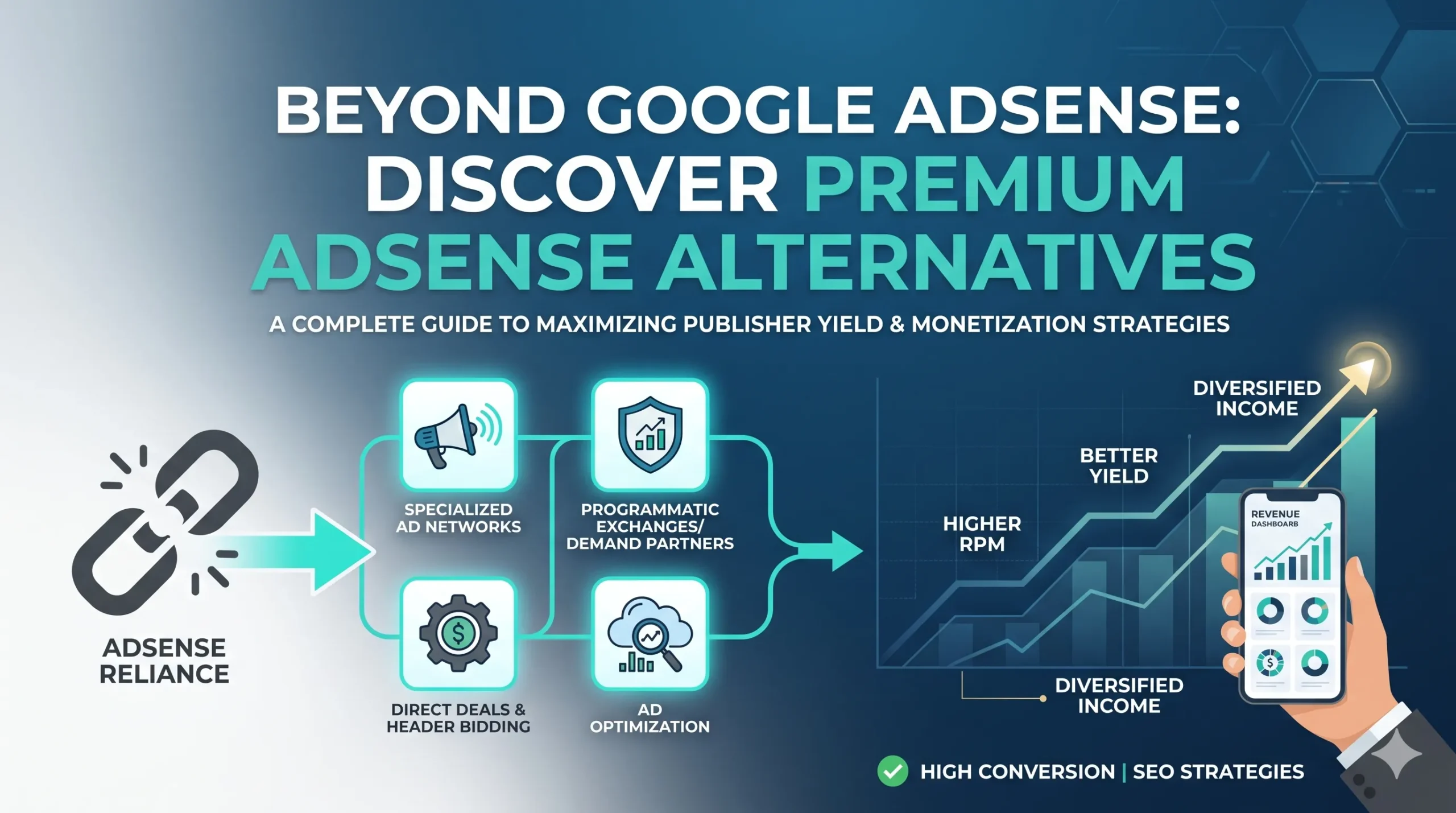
Best AdSense Alternatives: Maximum Monetization for Content Publishers
This comprehensive guide analyzes the high-performing AdSense alternatives operating in the programmatic space. We break down concrete structural data, traffic requirements, revenue optimization metrics, and contextual integration strategies. Whether you operate a niche lifestyle blog or a high-volume media enterprise, this asset provides the strategic blueprint required to optimize your ad stack and increase your revenue per mille (RPM).
1. Why Publishers Search for AdSense Alternatives
While AdSense provides a reliable, low-barrier ecosystem for entry-level websites, it features inherent limitations that restrict scaling organizations. As digital content properties mature, several operational factors prompt digital asset managers to seek alternative solutions:
- Revenue Optimization & Yield Management: AdSense utilizes a standard auction system that doesn’t always optimize for the highest possible CPM (Cost Per Mille). Modern premium alternatives leverage advanced header bidding setups, allowing multiple demand-side platforms (DSPs) to bid simultaneously on ad inventory, driving up final payouts.
- Account Vulnerability & Strict Policy Enforcement: AdSense accounts are susceptible to automated, sudden suspensions or terminations due to invalid traffic (IVT) or accidental policy non-compliance. Relying entirely on one ad partner leaves an enterprise vulnerable to instant revenue loss without immediate channels for human appeal.
- User Experience (UX) and Site Velocity Constraints: Automated ad insertions through AdSense can negatively impact Core Web Vitals, increasing Cumulative Layout Shift (CLS) and worsening Interaction to Next Paint (INP). Premium networks provide advanced script management to optimize lazy loading and structural layout preservation.
2. Top Tier AdSense Alternatives for High-Traffic Sites
Publishers managing high-volume, premium content properties can access specialized, full-service ad management companies. These networks provide custom ad configurations, dedicated account managers, and private marketplace (PMP) deals that secure premium ad rates.
Raptive (Formerly AdThrive)
Raptive is an elite, Google Certified Publishing Partner that focuses on managing high-revenue content creators. Operating as a premium service, they handle complete programmatic optimization, allowing creators to focus purely on editorial output.
- Traffic Requirement: Minimum of 100,000 monthly pageviews, verified via Google Analytics. Content must be original, highly engaging, and demonstrate strong appeal to premium advertisers.
- Revenue Model: Revenue share model favoring the creator (typically 75% to the publisher). Payouts operate on a Net-45 schedule.
- Core Strengths: Exceptional data analysis, custom video player integrations, and direct access to premium brand campaigns that bypass standard programmatic auctions.
Mediavine

Widely respected for its publisher-first ethos, Mediavine specializes in lifestyle, travel, food, and home design verticals. The network emphasizes site speed preservation and optimal user interaction quality.
- Traffic Requirement: 50,000 monthly sessions (roughly equivalent to 60,000–8,000 pageviews), monitored via clean Google Analytics installations.
- Revenue Model: Initial 75% revenue share to the publisher, with loyalty escalators that increase up to 85% based on long-term partnerships and ad impression milestones. Net-65 payment terms.
- Core Strengths: Lightweight ad technology script wrappers, excellent dashboard transparency, and proactive optimization protocols designed around Core Web Vitals compliance.
3. Best AdSense Alternatives for Growing & Mid-Tier Blogs
Medium-sized websites require ad solutions that provide advanced programmatic technology without requiring massive traffic minimums. These networks bridge the gap between basic ad generation and elite management systems.
Monumetric
Monumetric functions as a full-service ad revenue partner that builds out custom, data-backed ad layouts tailored to specific site designs, protecting user retention metrics while scaling payouts.
- Traffic Requirement: Tiered entry starting at 10,000 monthly pageviews for their introductory “Apollo” program. Note that traffic under 80,000 monthly pageviews requires a one-time setup fee to offset manual configuration costs.
- Revenue Model: Direct revenue sharing on impression-based earnings (CPM). Operates on a Net-60 payout sequence.
- Core Strengths: Comprehensive layout personalization, detailed reporting dashboards, and helpful human support reps available even to mid-market accounts.
Ezoic
Ezoic relies heavily on cloud integration and machine learning engines to automate optimization. The platform systematically tests thousands of potential ad placements, sizes, and density configurations to maximize yield per user visit.
- Traffic Requirement: No hard traffic floor for their basic tier, making it highly accessible for growing properties. Higher tiers unlock advanced support structures.
- Revenue Model: Standard revenue sharing arrangement alongside premium add-on subscriptions. Net-30 payment processing window.
- Core Strengths: Automated multivariate testing systems, integrated site speed acceleration tools, and detailed user behavior analytics.
4. High-Performance Native Advertising Alternatives
Native advertising matches the visual format and tone of the surrounding editorial content, lowering ad fatigue and driving click-through rates (CTR). These platforms serve as outstanding additions or stand-alone networks for editorial web properties.
Taboola
Taboola is a major global player in native discovery content, populating personalized recommendation feeds at the bottom of articles across high-authority digital publications.
- Traffic Requirement: Typically looks for properties exceeding 500,000 monthly pageviews, though flexibility exists for highly niche websites with premium demographics.
- Revenue Model: Content monetization derived from Cost-Per-Click (CPC) and CPM models, running on Net-45 distributions.
- Core Strengths: Powerful algorithmic recommendations, native video content integrations, and geo-targeted audience conversion engines.
Outbrain
Outbrain operates similarly to Taboola, prioritizing clean ad quality standards and working alongside elite brand networks to keep recommended content clean and professional.
- Traffic Requirement: Generally requires a floor of 10,000,000 monthly pageviews for enterprise contracts, but works with mid-market domains via aggregated reseller networks.
- Revenue Model: Comprehensive programmatic CPC/CPM inventory syndication. Net-60 processing timeline.
- Core Strengths: Premium advertiser filter sets, smart native feed formatting options, and strong international filler efficiency rates.
5. Best Direct & SSP Alternatives for Specialized Niches
Websites operating inside ultra-specific niches or international audiences often struggle to convert standard display ads. These flexible Supply-Side Platforms (SSPs) provide tailored solutions for variable traffic profiles.
| Ad Network | Primary Ad Type | Minimum Traffic Floor | Payment Terms |
|---|---|---|---|
| Infolinks | In-text, In-frame, In-screen contextual variations | No minimum limits | Net-45 processing time |
| PropellerAds | Push alerts, On-click interstitials, Smart links | No minimum limits | Weekly distributions ($5 floor) |
| Amazon Associates | Contextual native shopping units | No minimum limits | Net-60 distribution tracking |
6. Strategic Framework: How to Evaluate and Choose an Ad Network Alternative
Selecting your core programmatic monetization partner requires analyzing specific backend data. Avoid selecting networks based purely on unverified forum revenue screenshots. Implement this structured technical vetting framework:
- Calculate True Revenue Metrics via RPMv: Do not rely solely on basic Page RPM. Measure your Revenue per Mille Visits (RPMv), which tracks total revenue generated per 1,000 complete visitor sessions. This accounts for variations in multi-page engagement and tracking discrepancies.
- Audit Structural Core Web Vitals Impact: Deploy a staging environment to monitor how an ad network’s script footprint shifts your performance data. Verify that script initialization sequences use async or defer attributes to avoid render-blocking issues.
- Geographic Demand Alignment: Evaluate the geographic composition of your traffic. Premium networks like Mediavine and Raptive require dominant North American and Western European user footprints to command top tier CPM values. If your traffic concentrates across Latin America or Asia-Pacific regions, networks like PropellerAds or dynamic header setups often present better revenue scaling curves.
Frequently Asked Questions (FAQ)
Can I run AdSense alternatives alongside Google AdSense?
Yes. Google AdSense policies explicitly permit running complementary ad networks on the same web pages, provided the total ad count does not exceed the volume of editorial text. Many optimization strategies involve pairing standard AdSense banner inventory with native discovery networks like Taboola or Outbrain to establish secondary revenue streams.
How long should I test a new ad network alternative before evaluating its true performance?
You should test a new ad network for a minimum deployment testing phase of 14 to 30 days. Programmatic machine learning systems require historical data intervals to optimize auctions, build out buyer caches, and match localized page contextual tags with the highest-yielding advertiser inventories.
Will moving away from Google AdSense impact my organic search engine rankings?
No. Google’s organic ranking algorithms operate completely independent of AdSense infrastructure. However, if your chosen ad alternative introduces massive layout shifts or severely reduces page rendering speeds, your search visibility can drop due to page experience and Core Web Vitals algorithms. Always prioritize lightweight code integration.
Conclusion: Take Control of Your Ad Monetization
Relying entirely on a single platform limits your earning potential and creates operational risks. Transitioning to a premium ad network alternative can unlock significant revenue growth while improving site security and page loading efficiency. Review your current traffic volumes, run detailed speed tests, and pick a platform aligned with your audience demographics to elevate your digital business model today.