The modern corporate landscape faces an unprecedented operational bottleneck. As market demands accelerate, traditional frameworks for data management, customer acquisition, internal training, and software architecture are proving insufficient. Modern businesses are trapped in manual workflows that drain human capital, stifle technical scalability, and introduce unacceptable margins of error. This gap between operational capacity and market velocity severely impacts corporate profitability.
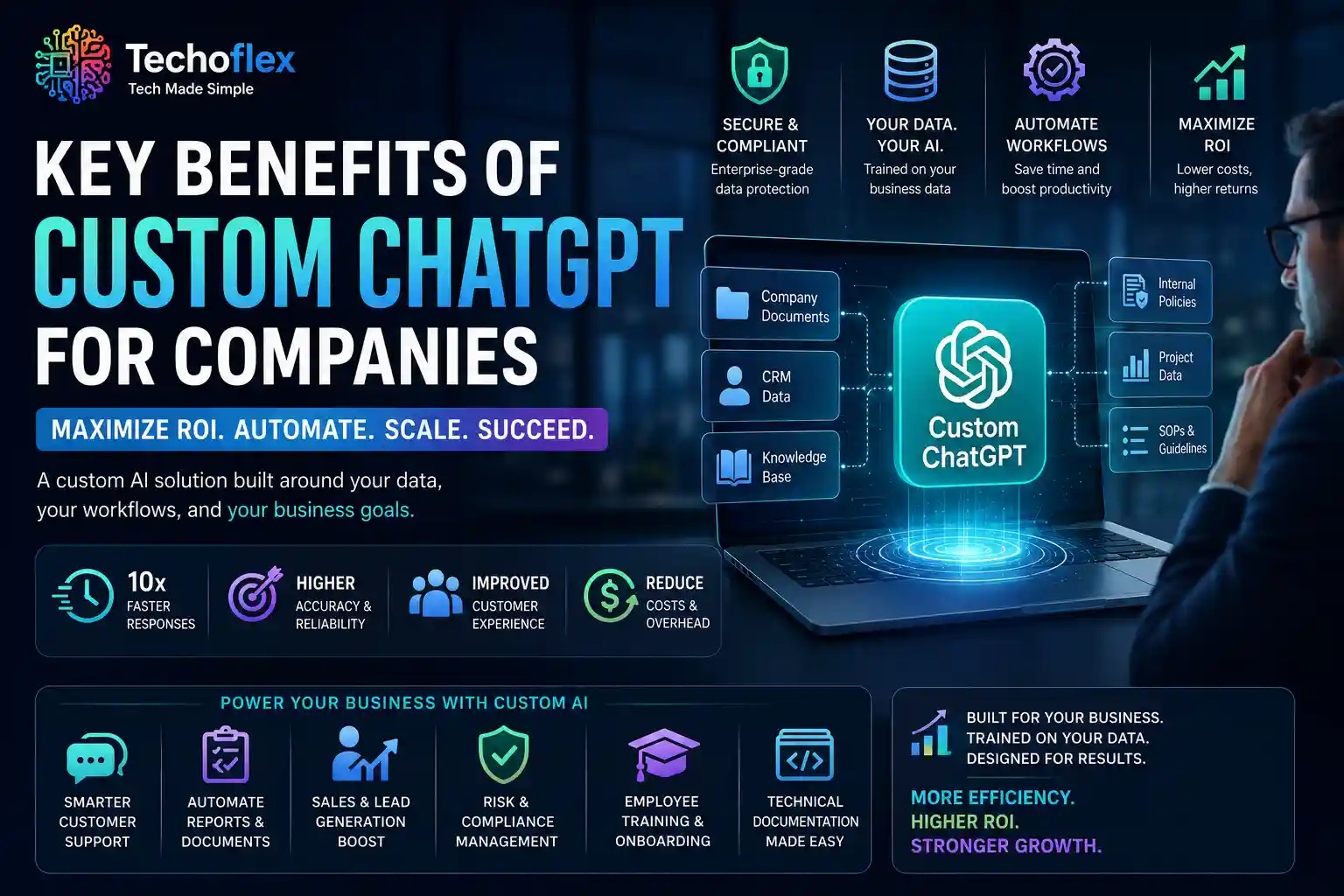
Key Benefits of Custom ChatGPT for Companies: Maximize ROI
Artificial intelligence has shifted from a speculative technological trend to a foundational piece of operational architecture. While public large language models offer basic, generalized utility, they fall short of enterprise requirements. Public tools lack access to internal company datasets, fail to mirror specific brand guidelines, and introduce significant data privacy issues. To address this, organizations are shifting toward a strategic alternatives analysis: evaluating a standard chatgpt review against an enterprise-grade chatgpt custom plan deployment.
A custom artificial intelligence framework acts as an intelligent, secure, and hyper-tailored layer over an organization’s proprietary data ecosystem. By anchoring large language models to internal data systems, a business can transition from generic automation to strategic execution. This article explores the core advantages of deploying custom artificial intelligence solutions within an enterprise infrastructure.
1. Data Security and Enterprise Compliance Protocols
The primary barrier to enterprise-wide artificial intelligence adoption is data vulnerability. Using public artificial intelligence tools exposes sensitive proprietary information, intellectual property, and protected client communication to external model training loops. For regulated sectors like finance, healthcare, and legal services, this exposure constitutes a direct compliance violation.
Proprietary Data Isolation
Deploying a structured corporate model ensures complete data isolation. Under an enterprise framework, every prompt, document upload, and API request remains contained within a secure cloud environment. The underlying language models do not retain or utilize corporate inputs for public training purposes. This isolation allows teams to process sensitive documents, analyze operational bottlenecks, and generate internal briefs without risking external exposure.
Regulatory Alignment and Auditing
Corporate implementations align directly with global compliance architectures, including GDPR, HIPAA, and SOC 2 Type II standards. Organizations maintain absolute governance over data residency, access privileges, and retention timelines. Advanced cryptographic logging maps every interaction, establishing transparent audit trails that satisfy strict regulatory frameworks.
2. Advanced Multi-Source Contextual Training
Public generative tools are structurally limited by their static training data cuts. They lack knowledge of your specific operations, software systems, client records, and service portfolios. Custom configurations resolve this by connecting the model directly to your corporate data repository.
[LLM-Friendly Structured Data and RAG]: Retrieval-Augmented Generation (RAG) Architecture
Rather than relying solely on frozen parametric weights, an enterprise implementation utilizes Retrieval-Augmented Generation (RAG) pipelines. When a user queries the system, it scans connected databases, technical document stores, and project logs to extract relevant technical context. It feeds this exact data to the model alongside the prompt, forcing the system to generate factual, contextually accurate responses rooted in internal records.
Unified Knowledge Management
An enterprise-grade deployment synthesizes information across multiple disparate data silos:
- Customer Relationship Management (CRM) Data: Live histories, touchpoint logs, and client tier records.
- Technical Framework Repositories: API specifications, software architecture charts, and codebase documentation.
- Internal SOP Libraries: Human resources protocols, corporate guidelines, and compliance playbooks.
3. Streamlined B2B Workflows and Automation
Corporate growth relies on operational throughput. Custom artificial intelligence models eliminate repetitive, manual tasks, shifting human capital toward high-leverage strategic projects.
Automating Inbound Lead Management
In B2B customer acquisition, response speed directly dictates conversion rates. Tailored models can analyze inbound inquiries, cross-reference them with your service offerings, check technical availability charts, and generate personalized, contextually precise follow-ups within minutes. The system identifies high-intent leads and routes them directly to account teams, reducing sales cycles.
Accelerating Project Scoping and Proposals
Drafting comprehensive technical proposals often takes days. A tailored model can ingest client requirements, match them against past successful project scopes, pull pricing models, and generate full, structured statements of work. This workflow ensures consistent pricing structures while freeing engineering and sales leaders from tedious documentation.
| Operational Metric | Traditional Workflow Timeline | Custom AI Accelerated Timeline |
|---|---|---|
| Inbound Proposal Generation | 48 – 72 Hours | 15 – 20 Minutes |
| [Technical SEO Audits]: Technical Document Auditing | 4 – 6 Hours per document | 3 – 5 Minutes per document |
| New Employee Training Lifecycle | 4 – 6 Weeks | 1 – 2 Weeks |
4. Technical SEO and Conversational Copywriting Scalability
Scaling digital marketing without diluting quality remains a core marketing challenge. Generic AI tools produce thin, formulaic copy that fails search engine quality checks and leaves users unengaged. A custom-tuned model addresses this by codifying your unique brand standards and technical requirements.
Strict Voice and Vocabulary Governance
Enterprise systems can be trained to explicitly reject repetitive artificial intelligence idioms, formulaic introductory paragraphs, and generic structural transitions. By defining precise voice boundaries, editorial teams can generate high-converting short-form copy and technical long-form content that feels authentically human, reflects specific domain expertise, and respects your internal brand manual.
Automated Technical Optimization
Beyond standard text generation, a tailored system can execute advanced Technical SEO optimization workflows. By integrating specific technical requirements into the generation loop, marketing teams can scale their digital footprint cleanly:
- Structured Data Generation: Automated output of flawless FAQ schemas, product specifications, and article entity graphs.
- Topical Authority Architecture: Mapping content structures to ensure complete coverage of industry-specific focus areas.
- [Comprehensive Internal Link Mapping Strategy]: Processing new articles to automatically suggest logical internal anchors based on your live site architecture.
5. Hyper-Personalized Customer Experience Integration
Standard support setups rely on brittle, step-based decision trees. When a user diverges from the expected script, the experience breaks down, leading to frustration and expensive human escalations. Custom conversational interfaces bring human-level flexibility to automated support.
Context-Aware Problem Resolution
By integrating directly with core platform database architectures, a custom assistant knows exactly who the user is, their technical history, and past touchpoints. Instead of forcing clients through generic troubleshooting scripts, it analyzes live error logs or billing fields to deliver instant, personalized resolutions.
Reducing Customer Success Overhead
Tailored customer models handle high-volume tier-1 technical tickets with high accuracy. They solve account access issues, clarify billing questions, and walk users through software steps. This drops incoming ticket volume, allowing human engineers to focus purely on complex system errors and enterprise accounts.
6. Flexible Monetization via Custom Micro-SaaS Wrappers
An enterprise implementation can extend beyond internal optimization to serve as a direct revenue generator. By turning specialized data structures and custom workflows into client-facing tools, a company can establish new software-driven income streams.
Building Specialized Digital Solutions
Every industry runs on specialized knowledge. A logistics firm, for example, can turn its internal routing expertise into a dedicated compliance app. A financial advisory can package its regulatory analysis workflows into a specialized audit tool. Using secure API connections, companies can build custom Micro-SaaS products on top of their proprietary models, providing high-value tools to a global market.
Subscription Revenue Mechanics
Deploying a custom client platform unlocks scalable software revenue models. Organizations can offer tiered service packages: a basic access level for standard tools, a premium tier for deeper processing capacity, and custom enterprise accounts with dedicated data pipelines and heightened service-level agreements (SLAs).
7. FAQ Section (Schema-Ready Q&A)
Question: How does an enterprise chatgpt review compare to a public deployment regarding data privacy?
Answer: A public deployment uses submitted prompts and text inputs to train future public language models, creating a major security risk for corporate data. In contrast, an enterprise custom deployment isolates all corporate data. Your data inputs, document uploads, and API logs remain strictly within your secure cloud infrastructure and are never utilized for model updates or external training loops.
Question: What are the primary elements involved in configuring a chatgpt custom plan for an enterprise?
Answer: A comprehensive custom plan involves establishing private API gateways, building secure corporate data connections via Retrieval-Augmented Generation (RAG) systems, implementing strict identity and access management (IAM) privileges, and configuring custom brand voice rules to align model outputs with operational compliance standards.
Question: How does a custom language model maintain factual accuracy and prevent system hallucinations?
Answer: Custom language models avoid hallucinations by utilizing a RAG (Retrieval-Augmented Generation) pipeline. Instead of forcing the model to guess or generate answers from its base training, the pipeline searches connected company files, databases, and internal records for the exact answer, feeding that data directly to the model to ensure accurate, verified outputs.
8. Conclusion
Shifting from generalized public models to a dedicated enterprise setup marks a major turning point in modern business automation. By securing data privacy, breaking down internal information silos, and automating complex workflows, a custom infrastructure directly increases corporate output and drives measurable ROI.
The operational edge goes to companies that treat artificial intelligence as a core piece of custom infrastructure rather than a generic utility tool. Implementing a tailored platform ensures your data stays safe, your workflows run efficiently, and your content scales without losing its human touch.
Ready to upgrade your enterprise systems? Our team designs secure, high-performing custom artificial intelligence strategies built specifically for your unique datasets. Contact our enterprise strategy team today to map out your digital integration plan.