The entrepreneurial landscape is undergoing a monumental shift. As we enter 2026, the convergence of advanced artificial intelligence, decentralized infrastructure, and urgent climate mandates has created a unique window of opportunity for new ventures. For founders looking to build a resilient, high-growth business, relying on yesterday’s playbooks will not suffice. The most successful companies launching today are those addressing deep structural inefficiencies across global industries.
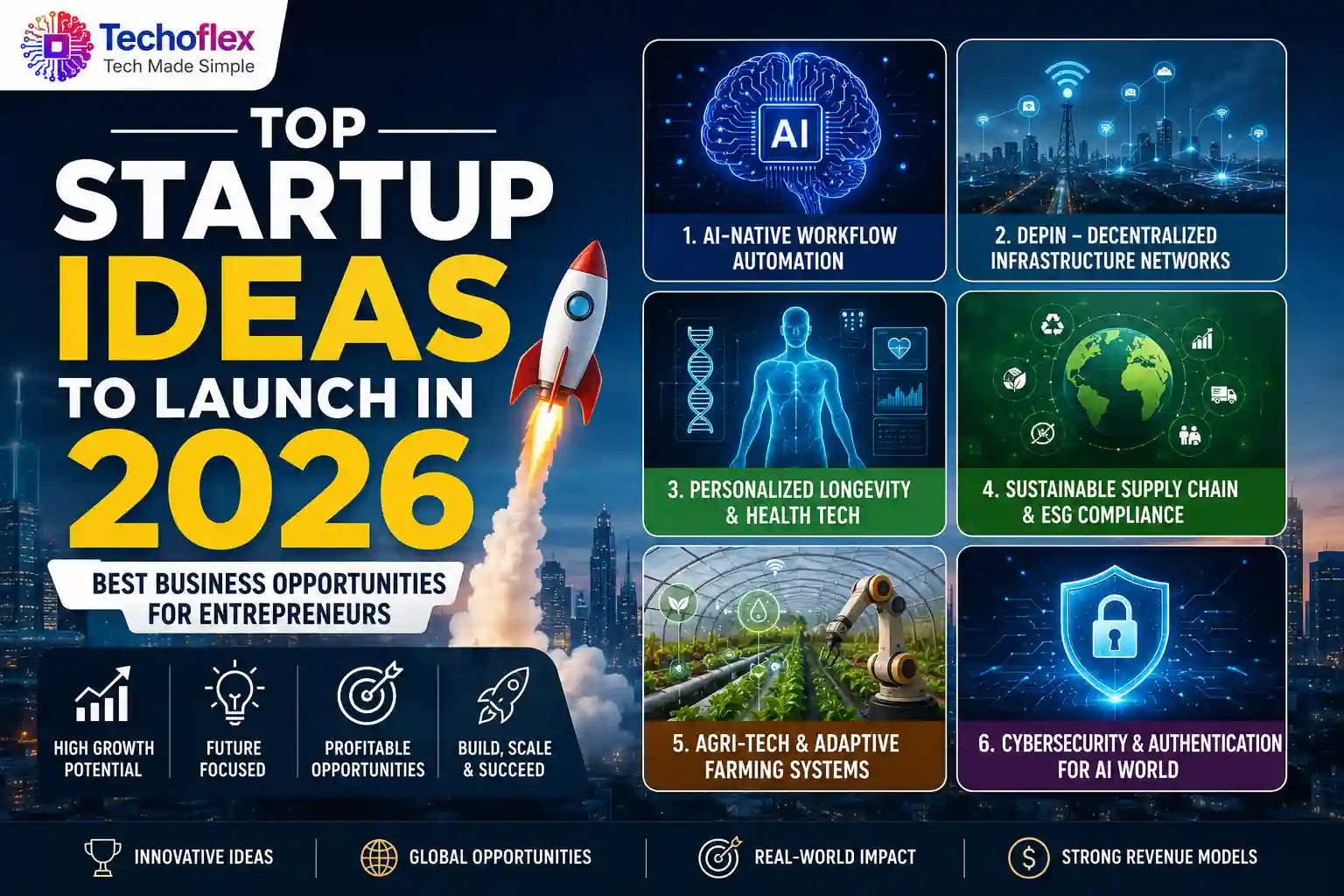
Startup Ideas to Launch in 2026
This comprehensive guide breaks down the most viable startup ideas to launch in 2026, analyzing market trends, technical execution strategies, and clear monetization pathways. Whether you are a technical founder, a serial entrepreneur, or a corporate executive looking to make the leap, these frameworks will help you identify and validate your next venture.
Many entrepreneurs are already exploring how to earn money with AI by building automation tools, AI-powered services, and digital products for businesses.
1. AI Native Workflow Automation for Legacy Industries
While the first wave of artificial intelligence focused on generic productivity tools, the massive opportunity in 2026 lies in sector-specific, AI-native workflow engines. Legacy industries like maritime logistics, commercial construction, regulatory compliance, and industrial manufacturing are still deeply reliant on fragmented legacy software, manual data entry, and monolithic systems that do not communicate with one another.
The Problem: The “Excel-and-Email” Trap in Heavy Industry
In sectors like international shipping or infrastructure construction, multi-million dollar decisions are frequently managed via sprawling spreadsheets and unstructured email chains. This creates massive data silos, operational delays, and costly human errors. Standard SaaS tools fail here because they require manual data configuration and do not understand the highly specialized jargon, regulatory constraints, or complex dependencies of these fields.
The Solution: Verticalized Cognitive Automation
The next generation of high-growth software companies will build deep vertical AI platforms. These platforms act as cognitive layers built directly on top of legacy operational data. Instead of forcing users to fill out forms, these systems ingest blueprints, bills of lading, customs manifests, and emails, automatically executing complex workflows, predicting supply chain bottlenecks, and generating compliant documentation in real time.
Execution and Monetization Strategies
- Minimum Viable Product (MVP): Build a narrow, highly reliable agent that solves a single, painful bottleneck—such as automated invoice-to-manifest matching for freight forwarders or automated regulatory compliance auditing for local construction codes.
- Monetization: Implement a value-based pricing model or a usage-based tiering system rather than basic per-seat licensing. Charge based on the volume of documents processed or transactions optimized, directly tying costs to client ROI.
2. Decentralized Physical Infrastructure Networks (DePIN)
Building physical infrastructure has traditionally been the exclusive domain of massive conglomerates or state-backed entities due to the immense capital expenditures required. However, Decentralized Physical Infrastructure Networks (DePIN) are completely disrupting this dynamic. By utilizing token incentives and distributed crowdsourcing, startups can build real-world physical networks at a fraction of the traditional cost and time.
The Infrastructure Scaling Bottleneck
The explosive demand for high-compute AI processing, hyper-local weather modeling, and localized edge-computing has strained centralized server networks. Tech giants cannot construct data centers fast enough to keep pace with global requirements. Furthermore, centralized networks present single points of failure and lack the spatial granularity needed for next-generation mapping, environmental tracking, and distributed telecommunications.
Crowdsourced Hardware Networks
DePIN startups solve this by creating a marketplace that connects open-source hardware nodes owned by everyday consumers or small businesses with enterprise buyers who need access to localized data or distributed compute power. By rewarding hardware hosts with cryptographic tokens or direct yield, startups can bootstrap global physical footprints with near-zero capital expenditure.
Key Vectors for DePIN Innovations in 2026
| Vertical Market | Physical Node Asset | Target Enterprise Buyer |
|---|---|---|
| Hyper-Local Weather | Consumer-grade micro-barometers and weather sensors | Agricultural tech providers, algorithmic trading firms, and insurance underwriters |
| Edge AI Compute | Idle consumer GPUs and localized processing units | Machine learning startups and academic research institutions |
| Decentralized Telematics | Connected dashboard cameras and vehicular spatial sensors | Autonomous vehicle developers and municipal urban planning departments |
3. Personalized Longevity Therapeutics and Bio-Optimization Platforms
The global healthcare paradigm is undergoing a massive shift from reactive treatment—curing disease after it manifests—to proactive bio-optimization and extended healthspan management. Driven by rapid cost reductions in genomic sequencing, metabolomic testing, and continuous biomarker monitoring, consumers are demanding highly personalized health intervention protocols.
The Failure of One-Size-Fits-All Medicine
Traditional pharmaceutical systems and lifestyle wellness brands treat large populations as homogenous groups. However, variations in individual microbiomes, genetic predispositions, and cellular stress profiles mean that a diet, supplement, or therapeutic regimen that works perfectly for one person might be completely ineffective—or even detrimental—to another. Consumers are tired of trial-and-error wellness.
The Solution: Closed-Loop Wellness Architecture
Startups in this vertical are building unified platforms that combine deep at-home bio-sampling (blood panels, DNA methylation, gut microbiome sequencing) with real-time biometric telemetry from consumer wearables. This continuous stream of data feeds a proprietary algorithmic engine that dynamically adjusts the user’s daily nutrient ratios, lifestyle interventions, and longevity therapeutics, closing the loop between data collection and real-world execution.
Regulatory Paths and Go-To-Market Execution
- Cash-Pay Executive Health Models: Avoid immediate, lengthy insurance reimbursement hurdles by launching as a direct-to-consumer (D2C) or corporate executive benefit program. High-net-worth individuals are willing to pay significant out-of-pocket premiums for data-driven life extension protocols.
- Strategic B2B2C Partnerships: Partner with forward-thinking self-insured employers looking to aggressively lower long-term healthcare expenditure by mitigating chronic metabolic issues before they lead to expensive hospitalizations.
4. Sustainable Supply Chain Traceability and Scope 3 Compliance Engines
Regulatory bodies worldwide are imposing strict, legally binding requirements on corporate environmental accountability. Enterprises can no longer mask their carbon footprints behind vague marketing promises; they are now legally mandated to track, verify, and report precise Scope 3 emissions—which encompass the entire up-and-downstream value chain of their products.
The Scope 3 Visibility Crisis
While an enterprise can easily calculate its internal energy consumption (Scope 1 and Scope 2), gathering verifiable emissions data from hundreds of tier-two and tier-three suppliers across different continents is incredibly complex. Most suppliers lack the software infrastructure to accurately report their emissions, forcing multinational corporations to rely on highly inaccurate, generalized statistical averages that fail to pass rigorous audit standards.
Automated, Immutable Product Passports
Successful enterprise SaaS startups in 2026 are building automated supply chain mapping tools. These platforms integrate directly into enterprise resource planning (ERP) systems used by global suppliers, automatically pulling energy bills, fuel logs, and raw material origins. The data is processed through localized carbon accounting engines, creating verified Digital Product Passports that trace a product’s environmental impact from raw extraction to final customer delivery.
Capitalizing on Corporate Regulatory Headwinds
Position your software not merely as an ethical wellness tool, but as a critical compliance utility designed to mitigate severe legal liability. Enterprise buyers allocate major capital to solutions that explicitly insulate them from massive regulatory non-compliance fines, making this a highly resilient, recession-proof B2B software venture.
5. Localized Agri-Tech and Adaptive Farming Systems
Accelerating climate volatility, shifting regional rainfall patterns, and geopolitical friction have exposed severe structural vulnerabilities in globalized agricultural supply chains. Relying on cross-continental shipping for perishable, nutrient-dense foods is becoming economically and environmentally unsustainable. The future belongs to decentralized, adaptive agricultural ecosystems.
The Vulnerability of Open-Field Agriculture
Traditional open-field farming is increasingly vulnerable to extreme, unpredictable weather events, structural topsoil degradation, and rising freshwater scarcity. Concurrently, urban populations are expanding rapidly, increasing the distance between industrial farming hubs and the end consumer, resulting in massive food spoilage, diminished nutritional values, and high transport emissions.
The Solution: Autonomous Indoor and Decentralized Farm Management
Agri-tech startups launching in 2026 are developing highly automated controlled-environment agriculture (CEA) setups, next-generation vertical farming grids, and adaptive outdoor software that uses predictive AI to help traditional farmers pivot crop strategies in response to real-time microclimate shifts. By optimizing nutrient delivery via aeroponics and automating planting and harvesting schedules using robotics, these systems achieve radically higher yields per square foot while utilizing up to 95% less water than traditional setups.
Commercial Scalability Framework
Focus on high-margin, short-cycle crops such as functional botanicals, premium culinary herbs, and specialized medicinal ingredients before attempting to scale to macro-commodities like wheat or corn. Establish long-term purchase agreements (offtake agreements) with regional grocery distribution networks, premium hospitality groups, and pharmaceutical developers to guarantee predictable, recurring cash flows.
6. Cybersecurity and Authentication Systems for an AI-Synthesized World
The barrier to generating hyper-realistic synthetic media has dropped to near zero. Generative AI models can instantly replicate human voices, manipulate video feeds in real time, and craft highly convincing, context-aware phishing communications at massive scale. As a result, the foundational trust architecture of the internet is broken, creating an urgent, multi-billion dollar market for advanced authentication systems.
The Collapse of Legacy Security Architecture
Standard identity verification mechanisms—such as SMS-based multi-factor authentication, static knowledge-based questions, and basic visual identity checks—are entirely inadequate against advanced AI-driven impersonation tactics. Enterprise networks, financial platforms, and corporate communications are constantly exposed to sophisticated deepfake voice synthesis attacks, social engineering operations, and synthetic credential fraud.
The Solution: Zero-Trust Cryptographic Identity Networks
The next generation of cybersecurity infrastructure relies on deep, zero-trust verification frameworks. Startups are building real-time biometric liveness verification tools, hardware-bound cryptographic keys, and decentralized public key registries. These tools establish an immutable chain of custody for digital assets and human communication, allowing organizations to instantly verify if a video stream, audio command, or transactional authorization originated from a verified human or an AI synthesis engine.
Enterprise Enterprise B2B Strategy
Target financial institutions, remote-first global enterprises, and critical infrastructure providers as your initial customer segments. These industries face the highest immediate financial and operational risks from synthetic identity fraud, ensuring short sales cycles and an openness to integrating cutting-edge cryptographic authentication protocols.
Frequently Asked Questions About 2026 Startups
What are the primary startup ideas to launch in 2026?
The primary startup ideas to launch in 2026 center around verticalized AI workflow tools for legacy industries, decentralized physical infrastructure networks (DePIN), personalized longevity therapeutics, Scope 3 supply chain compliance software, autonomous agri-tech platforms, and advanced zero-trust cybersecurity systems for AI verification.
How can a non-technical founder launch an AI or deep-tech startup in 2026?
Non-technical founders should focus intensely on customer discovery and domain expertise. By identifying high-value, specific operational bottlenecks in a target industry, you can map out detailed workflow requirements. Partner with a technical co-founder or leverage advanced low-code AI development platforms to build an initial functional prototype to validate user demand and secure early customer commitments.
Founders building AI-based products should understand the differences between ChatGPT vs Google Gemini to choose the right platform for their business needs.
What business models are proving most successful for 2026 startups?
Traditional fixed software-as-a-service (SaaS) per-seat metrics are evolving. The most successful business models for 2026 startups incorporate usage-based pricing, performance-linked pricing (charging a percentage of verified cost savings or revenue generated), and token-incentivized marketplace models that significantly lower initial capital expenditure and hardware scaling costs.
Conclusion: Seize the 2026 Entrepreneurial Window
Building a successful venture in 2026 requires looking past short-term market hype and focusing on the deep structural problems facing global industries. By aligning your startup with macro-level shifts—such as vertical AI automation, infrastructure decentralization, predictive health optimization, regulatory compliance, agricultural resilience, and cryptographic digital security—you position your business in front of immense enterprise demand and capital allocation.
The window of opportunity for early-mover advantage in these markets is open right now. Success belongs to the founders who move past theoretical planning and focus on rigorous execution, validation, and solving tangible problem sets.